aRT+tECHNOLOGY+βIOΛOGY
The threshold between art, biology and technology has always been my personal terra incognita, the edge of the map where hic sunt dracones
and it is no longer safe to wander….
There are two ways to get there as a contemporary intellectual explorer:
you can either spend decades pursuing biology, biotechnology, genetics, medicine, computational biology and specializing in all sorts of other niche sub-disciplines that cut knowledge at a million points and leave it bleeding (Isaac Asimov, Prelude to Foundation), or you can be a trickster, a jack of all trades and dip into various ponds of knowledge until they fulfill your various thirsts and learn how to communicate your findings with all sorts of beautiful languages …other than words…
I chose the second route, that of painting pictures and telling stories, that double as allegories for contemporary issues in biology, genetics and artificial intelligence.
And I have come to an understanding that both paths lead to certain truths. Of course in painting you can get away with a lot more. Historically humans have always painted the things they saw or could not see, things they deemed important , even sacred. Fluttery-legged bison in the Chauvet-Pont-d’Arc Cave, austere saints in Byzantine iconography, luscious nymphs in Renaissance paintings, calm dusk scenes in the Realism Movement: Painting has always been a research methodology for humans in the same way contemporary lab researchers might conduct an entirely speculative experiment in order to understand what they’re dealing with. Both methods are a way of playing (homo ludens) to further our knowledge and enrich culture and science.
My recent exhibition titled ΤΗΕΟGONY concerned a pseudo-religious narrative about two factions of young people which have been arbitrarily placed on a somewhat barren terrain. They are both trying to create or capture a being to believe in and transform it into a kind of totem and whether that creature wants to become a totem or not is a completely different story…
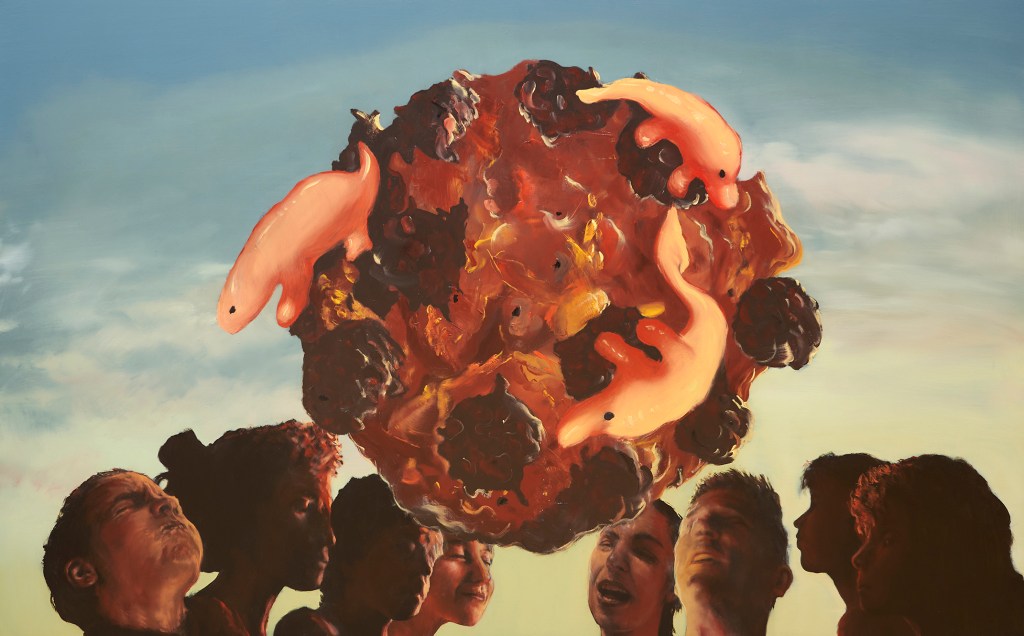
There are layers of allegory in this series, the most prominent for me being CREATION. How does a creator go about creating? By incorporating elements from other divine creations around him or her, by fabricating novelties out of thin air or perhaps both?
This is an issue that has been ringing in my head a lot the past year because of the new AI text-to-image tools that have been developed and I have experimented with and incorporated into my visual methodology. What is the role of AI in the production of human culture and what’s at stake concerning the element of imagination?
Before that, my large body of work entitled The Digital Messiah concerned genetics, synthetic biology and the concepts of sacrifice , scape-goatish rituals in ancient and contemporary western culture. My theoretical and visual research dealt with issues of digital ontology, contemporary digital religion and Cloud culture. Specifically, I investigated the artistic and philosophical aspects concerning the nature of a future DNA-based cloud storage system and humanity’s place in the new scheme of things. The paintings depicted episodes from the Pathos (religious Passion) of a fictitious character I created (whom I incarnate) and who is a type of contemporary Messiah – a digital Messiah- who has been backed up to a Cloud created from DNA and is constantly making efforts to save humanity while dealing with all the human stories backed up into his Cloud habitat simultaneously.
My theoretical PhD accompanied by the visual investigation gravitates around the contemporary developments in DNA data storage onto synthetic DNA which is an area of intensive tech research and obviously brings forth connotations of a Pandora’s Box or an Ark of the Covenant, a single DNA device that fits all of human civilization into a cubic meter.
My current work, Hic Sunt Dracones which pertains to the mythological visual history of monsters in Art and how I can create a contemporary mythology full of new monsters and new myths. Many of these monsters are related to current developments in genetics and AI and the role of humans in this new world.
There are indeed two ways of observing the world around us and within us, but the advantage of the Artist as opposed to the Scientist is the beautiful lack of liability, the total freedom of movement and the ideally child-like approach to knowledge which can sometimes bear extremely fresh fruit, a strange hybrid that the ultra-specialized academic is too short-sighted to detect and not eloquent enough to portray in a universally appealing manner. Most of the time though, I am happy enough with just painting even if the outcome is completely inconsequential for the scientific matters that interest me.
Whatever the route though, both the Scientist and the Artist obsessively observe the world-not themselves- and this is the ultimate act of love for the world surrounding us or swimming in us and that is what research is ultimately about….
 z(AI)gote
Leave a comment