βy Αspasia Destouni
The first gaze
Tate is my perennial refuge in London. Back in 2017, I visited the collections just a few hours before boarding the Eurostar to Brussels. I was a postdoc at KULeuven and through my project I became fascinated by zygotes. A zygote is not only the fancy, difficult to pronounce, Greek term for a fertilized egg. It is the phenomenal beginning of a new life from two cells, a sperm and an egg, burdened (or blessed) with executing the very first step in the lifetime of a new being: their union and subsequent reprogramming into a single-cell embryo. This single-cell will then start ‘dancing’ its way (as Magdalena Zernicka-Goetz puts it in her book) into becoming a whole, perfectly functioning new organism.
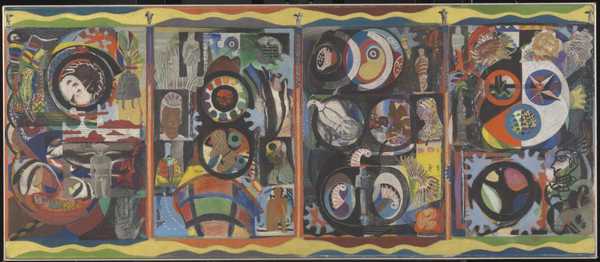
Back at the Tate, my subconscious was secretly processing embryos while my conscious brain was craving aesthetic pleasures from art in a game of cheating science and all its rigorous methodological constraints with art’s unique way of “giving a finger” to the natural laws . Francis Bacon usually monopolizes my gaze but that day another painting caught my eye. Instead of Bacon’s destroyed and gloriously painted monstrous figures of a human ‘shit bag’ that carries a soul capable for the most beautiful and most horrific things, I found myself drawn into a contemplation of enigmatic wavy patterns. The strictly segmented but interconnected array of ensembles made of round shapes and Greco-Roman and African statues, the orchestration of what seemed clear to me – that primal cell division—a sublime inception, marking the commencement of an intricate paganistic procession of forms and colors through rectangular segments resonating with developmental stages.
The title of the painting came as a much anticipated, mind blowing confirmation of the first gaze “The Autobiography of an Embryo”…..It literally invited me to dedicate my entire evening to thinking of how could an embryo tell its own story?
Who was Eileen Agar?
How could a female modernist with no apparent formative scientific education be appointed to the monumental task of painting that story?
What did scientists know about embryo development back in the 30’s?
The Autobiography of an Embryo” is a vivid and surreal depiction of the embryonic journey, captured through Agar’s unique artistic lens. Despite lacking the advanced imaging techniques available to contemporary biologists, in my dreamy view, Agar’s work resonates with the essence of embryonic development as we now understand it. It is a testament to the value of intuition in solving the mysteries of our natural world as we perceive it with our conscious minds. After all, John Steinbeck attests to that in his famous quote: “the free exploring mind of an individual human is the most valuable thing in the world”.
 z(AI)gote
Leave a comment